
How to Prep for Thanksgiving Dinner Ahead of Time: A Kitchen Timeline (Even With One Oven)

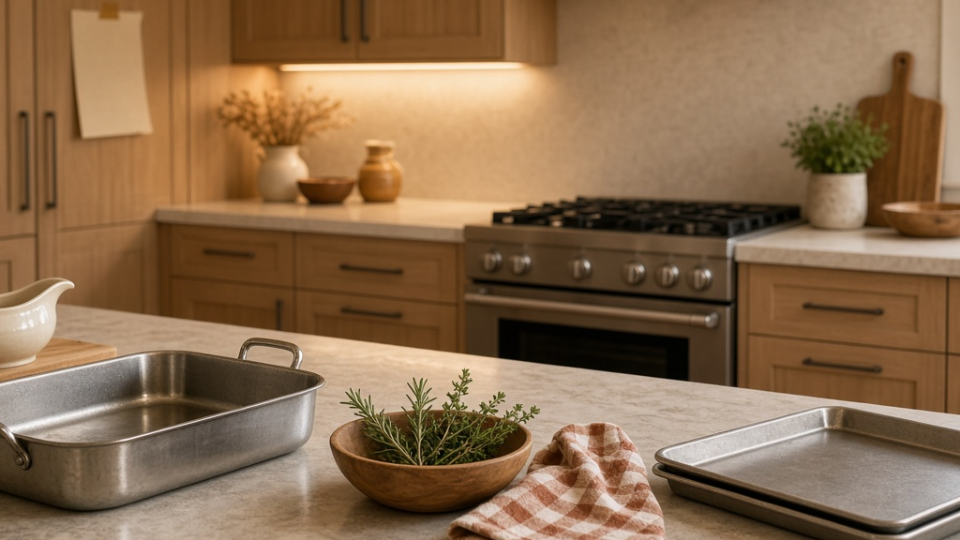
Run your kitchen like a schedule, not a scramble. Start the turkey thawing in the fridge days ahead, plan your oven time backward from when you want to eat, and give every job its own station. Most Thanksgiving kitchens don't run out of space. They run out of timing.
Here's the math that drives everything else. USDA says to allow about 24 hours of refrigerator thawing for every 4 to 5 pounds of turkey, so a 16- to 20-pound bird needs 4 to 5 days. An unstuffed 14- to 18-pound turkey roasts in about 3¾ to 4¼ hours at 325°F. That's a fridge shelf for most of the week and the oven for most of the afternoon. Plan those two things first and the rest of the kitchen falls into place.
1. Clear a fridge shelf before you buy anything else
The fridge is the first thing to run out, and it starts running out days before Thursday. USDA's thawing guide is the easiest planning tool you'll find:
| Turkey size | Thawing time in the refrigerator (40°F or below) |
|---|---|
| 4 to 12 pounds | 1 to 3 days |
| 12 to 16 pounds | 3 to 4 days |
| 16 to 20 pounds | 4 to 5 days |
| 20 to 24 pounds | 5 to 6 days |
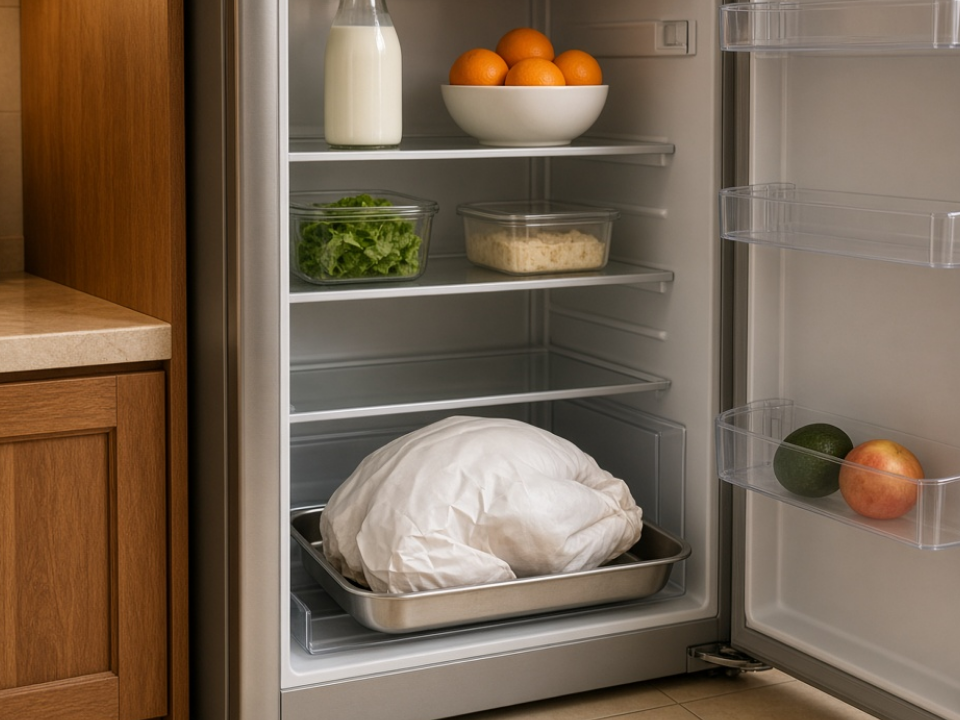
Keep the turkey in its original wrapper, on a tray or in a pan that catches drips. I put mine on the lowest shelf, so nothing drips onto anything else. Once it's thawed, it can stay in the refrigerator for 1 to 2 more days. So clear that shelf on the weekend, and shop for everything else around it.
If you're short on time, cold water works too: about 30 minutes per pound, changing the water every 30 minutes, and cook it right after. What doesn't work is the counter. USDA says never to thaw on the counter, in hot water, or in a garage or basement.
2. Build your oven schedule backward from dinner
One oven is the real constraint in most kitchens. So start with dinner time and count back.
USDA says to set the oven no lower than 325°F. Roasting times for an unstuffed bird run about 3 to 3¾ hours for 12 to 14 pounds, 3¾ to 4¼ hours for 14 to 18 pounds, and 4¼ to 4½ hours for 18 to 20 pounds. Those times are approximate, so the thermometer has the final word.
Here's the move most people miss. USDA recommends letting the turkey stand for 20 minutes before carving. That's your window. The second the bird comes out, the sides go in. Write the whole plan on one sheet and tape it to a cabinet: when the bird goes in, when it comes out, what goes in during the rest, and what can be reheated on the stovetop instead.
Here's what that looks like for a 4 p.m. dinner with a 16-pound unstuffed turkey. Take off the 20-minute rest, then the 3¾ to 4¼ hours of roasting, and the bird goes in somewhere between about 11:25 and 11:55 a.m.. Start checking the temperature at the early end. Everything else in the oven gets scheduled around that block.
3. Set up stations, not just counter space
Counter space feels like the problem, but it's usually traffic. When everyone's working on the same stretch of counter next to the stove, nothing moves. So split the kitchen up:
- Prep station: the board, knives and a trash bowl, away from the stove.
- Cooking station: the range and the counter right next to it, kept clear for hot pans.
- Serving station: a sideboard, an island end or a folding table, where finished dishes land.
- Drinks: out of the kitchen entirely, if you can. Then guests have somewhere to gather that isn't in front of the oven.
None of this needs a bigger kitchen. It needs a plan for the one you have.
Heading out before dinner? Here's what's on near DC Thanksgiving week.
4. Cook the stuffing outside the bird and trust the thermometer
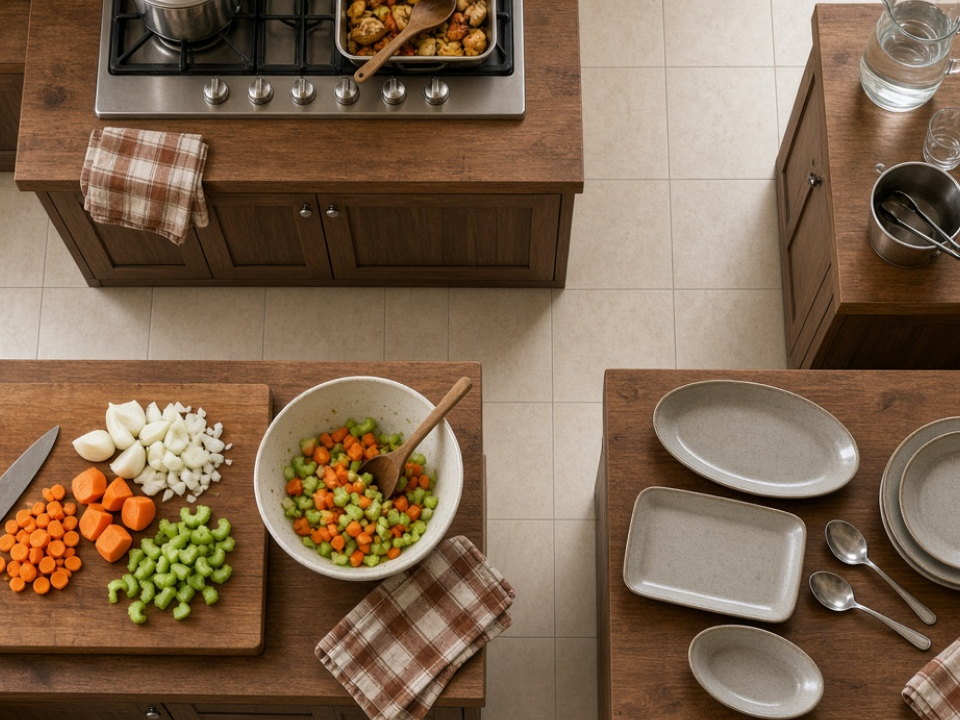
For the safest result, USDA doesn't recommend stuffing the turkey. Bake the stuffing in a casserole dish instead, and cook it to 165°F. That also frees up timing, because the dish can go in during the rest window.
The turkey itself is done at a minimum internal temperature of 165°F. Check the innermost part of the thigh and wing and the thickest part of the breast. Check it even if the turkey has a pop-up timer. And wash your hands, utensils and the sink after anything touches raw turkey.
5. Plan the leftovers before you sit down
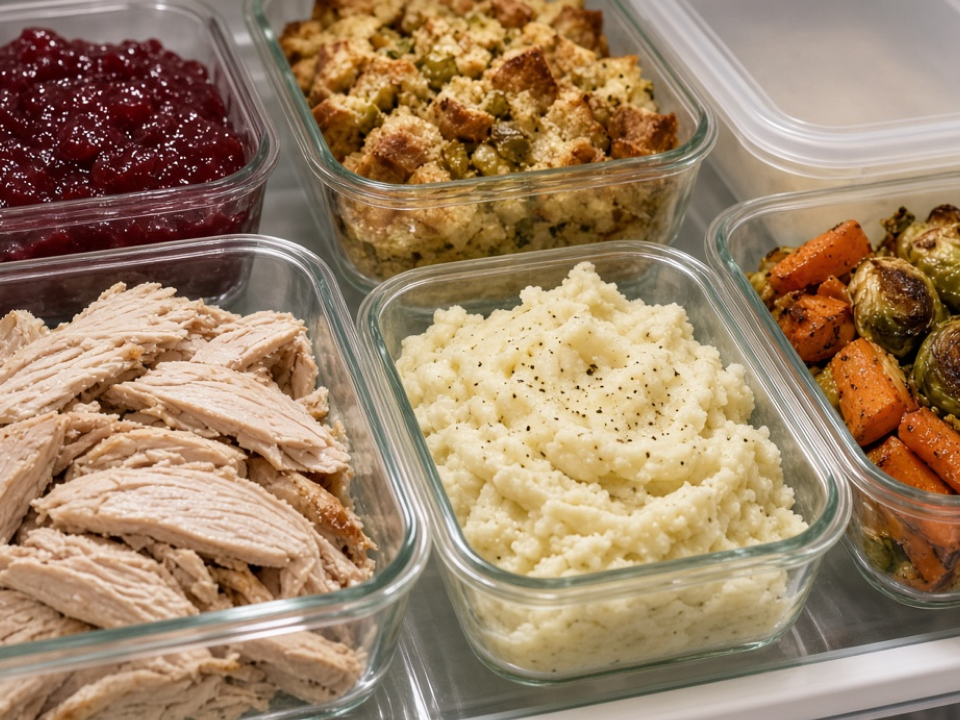
The last space crunch hits after dinner. USDA says to throw out turkey, stuffing and gravy left at room temperature for more than 2 hours. Split leftovers into smaller portions in shallow covered containers so they cool faster. Use refrigerated leftovers within 3 to 4 days, or freeze them and use them within 2 to 6 months for best quality. Set the containers out before you sit down, and the cleanup takes care of itself.
So what if your kitchen still doesn't work? There are three real options:
- Work the schedule harder. Roast earlier, use the rest window, and move sides to the stovetop or make them a day ahead.
- Borrow space. A countertop roaster, a cooler for drinks or a neighbor's oven for one dish can buy back an hour.
- Treat it as a housing need. If the kitchen is the bottleneck every single holiday, that tells you something about your next home. Note what's missing: a second oven, more counter run, an island, a pantry. Put it on the list.
That last one is where I come in. A Clarity Conversation starts with exactly this kind of question: what's missing in the house you're in today? If the kitchen keeps coming up, look at what's selling on the Silver Spring market page, and reach out when you want a straight read on which homes actually have the space you cook in.
Quick answers
How long does a turkey take to thaw in the fridge?
About 24 hours for every 4 to 5 pounds, per USDA. A 16- to 20-pound turkey needs 4 to 5 days.
Can I thaw a turkey on the counter?
No. USDA says never to thaw on the counter, in hot water, or in a garage or basement. Use the fridge, cold water, or the microwave.
How long do Thanksgiving leftovers last?
Use refrigerated leftovers within 3 to 4 days, or freeze them. Toss anything left out more than 2 hours, or more than 1 hour if the temperature is above 90°F, per USDA.
Happy Thanksgiving. Clear that shelf.
Move with Sven.
Sven Skarie / Real Estate Advisor, Real Broker
PREMIERE Group at Real Broker | buywithsven.com
Sven Skarie is a Real Estate Advisor with Real Broker, helping buyers and sellers in DC and Montgomery, Prince George's and Howard counties, Maryland. More about Sven.
Categories
Recent Posts